
# Why Most Churches Lose First-Time Visitors (And the Automated Follow-Up Fix That Changes Everything)
Every Sunday, churches across the country pray for new visitors. Pastors prepare their sermons, worship teams rehearse, and greeters stand at the doors with smiles and bulletins. And every Sunday, new people walk through those doors looking for hope, community, and a place to belong.
But by Monday morning, a silent crisis begins. According to church growth research, the average church in North America retains only about 15 percent of its first-time guests. In declining churches, that number drops to a staggering 6 percent.
That means if ten new people visit your church this Sunday, eight or nine of them will never come back.
It is rarely because they did not like the music or the preaching. It is almost always because they did not feel known, noticed, or connected after they left the building. When a visitor leaves a church and hears nothing but silence for a week, the unspoken message is clear: We didn’t really notice you were here.
What a Complete Visitor Follow-Up Looks Like
The problem is not that pastors do not care about visitors. The problem is that manual follow-up simply does not scale.
In most small to mid-sized churches, the visitor follow-up process looks something like this:
- A guest fills out a paper connection card and drops it in the offering plate.
- The cards sit on a desk until Tuesday when an administrator or volunteer types them into a spreadsheet.
- On Wednesday, the pastor tries to find time to call the numbers on the list. Half the time, it goes to voicemail.
- By Thursday, a generic form letter is mailed out.
- By Sunday, the visitor has already decided to sleep in or visit the church down the street.
This system relies entirely on human memory and available time. When the pastor gets called into an emergency counseling session on Tuesday, the follow-up calls do not happen. When the church administrator is out sick, the data entry gets pushed to next week.
Consistent follow-up is one of the clearest ways a church helps a first-time guest return. Guests have busy lives, and a single delayed email or a sporadic phone call gets lost in the noise of their week. To build a habit of attending church, a visitor needs multiple, consistent touchpoints that show genuine care.
The 48-Hour Window That Determines Everything
Timing is the most critical factor in guest retention, and the research is unusually specific about it. In How to Grow a Small Church, church growth researcher Bill Easum found that the return rate tracks directly with how fast the church makes contact — as summarised by the Lewis Center for Church Leadership:
| Contact made within | Likelihood the guest returns |
|---|---|
| 24 hours | 85% |
| 24 to 72 hours | 60% |
| More than 72 hours | 15% |
The drop between the first day and the third is the whole ballgame. A church that contacts guests on Sunday afternoon is playing a different game from one that gets to it on Wednesday.
But what kind of contact works best?
While phone calls and handwritten notes are still valuable, text is usually the most reliable first touch, simply because it gets read. It is immediate, unobtrusive, and does not require the guest to pick up a call from a number they do not recognise.
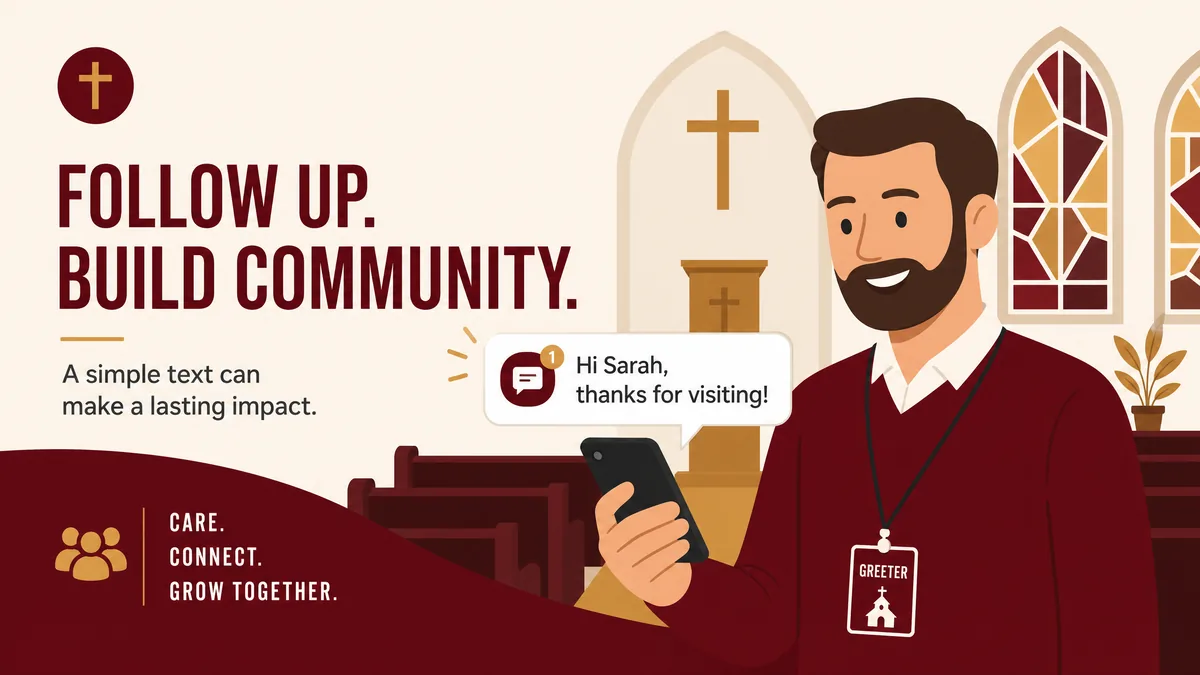
A simple text message sent on Sunday afternoon – “Hi Sarah, this is Pastor John. It was so great to meet you this morning! Thanks for joining us. Let me know if you have any questions about the church.” – does more to secure a second visit than a polished welcome packet mailed three days later.
“The goal of a church guest follow-up system is not to sell them on your church. It is to sustainably engage new visitors in a meaningful and consistent way so they feel comfortable enough to return.”
You Cannot Follow Up on Contact Information You Never Collected
Before any of this matters, a guest has to give you a way to reach them. This is where most follow-up plans quietly fail — not at week three, but at the connect card nobody filled in.
Three things move the completion rate more than anything else:
- Ask for less. A connect card with eleven fields gets skipped. Name, mobile number, email, and one checkbox for “I’m new here” is enough to start a conversation. Everything else can be asked later, once they have a reason to answer.
- Make it announced, not available. A card in the seat-back is invisible. A specific, unembarrassed thirty seconds from the stage — “if you’re new with us today, there’s a card in your seat or a QR code on the screen, and we would genuinely love to know you were here” — outperforms any redesign of the card itself.
- Offer both paper and digital. A QR code that opens a three-field form captures people who would never hand a card to a stranger. Paper still captures the people who do not want to take their phone out during a service. Run both; they reach different guests.
- Four fields or fewer on the first ask
- Announced from the stage every week, in the same place in the service
- QR code visible on screen for the whole announcement, not for five seconds
- A named person collects cards before the building empties
- Details entered the same day — not Tuesday
- An explicit opt-in checkbox for text messages, with the wording saved
Building a 6-Week Automated Follow-Up Workflow
To move a guest from a first-time visitor to a fully integrated church member, you need a system that communicates consistently over a six-week period. This is where church visitor follow-up automation becomes essential.
Using a church CRM like HighLevel, churches can build an automated workflow that triggers the moment a guest scans a QR code or fills out a digital connection card. The system handles the routine steps so every guest receives a timely follow-up, while each message still reads as personal to the person receiving it.
Here is what a proven, automated 6-week sequence looks like:
Week 1: The Immediate Connection
- Sunday Afternoon (Automated Text): A quick, friendly thank-you text from the pastor.
- Monday Morning (Automated Email): A brief email with links to the church’s social media and a digital welcome packet.
- Wednesday (Task Reminder): The system prompts a volunteer to write and mail a physical postcard.
- Saturday (Automated Text): A gentle reminder about tomorrow’s service times.
Week 2: Adding Value
- Wednesday (Automated Email): Information about the church’s children’s ministry or upcoming community events.
- Saturday (Automated Text): A short, encouraging scripture verse and a welcome back for Sunday.
Week 3: The Personal Touch
- Tuesday (Task Reminder): The system prompts the pastor or a staff member to make a quick personal phone call.
- Thursday (Automated Email): An invitation to a newcomer’s lunch or a small group.
Weeks 4 through 6: Deepening the Relationship
Over the final three weeks, the automated system spaces out the communication, sending one text or email per week. These messages focus on prayer requests, serving opportunities, and checking in to see how they are doing.
A consistent, multi-channel workflow means every guest gets the same follow-up, rather than only the ones somebody remembered to write down.
The Actual Words: Copy-and-Paste Follow-Up Scripts
Describing a six-week sequence is easy. Writing forty messages while running a church is not, and it is the reason most sequences stall after week two. Below is the copy, ready to adapt. Replace the bracketed fields, keep the tone, and cut anything that does not sound like the person whose name is on the message.
One rule throughout: every message should sound like it came from a person, because it did — you wrote it once instead of forty times.
Sunday afternoon — the first text
Hi [First Name], it’s [Pastor Name] from [Church Name]. It was really good to meet you this morning — thank you for spending part of your Sunday with us. If anything comes up this week, or you just have a question about the church, you can reply straight to this message.
Monday morning — the welcome email
Subject: Glad you were with us yesterday, [First Name]
Hi [First Name],
Thanks again for visiting [Church Name] yesterday. I wanted to send you one short email with the things people usually want to know in their first week — and then leave you alone to decide what’s next in your own time.
Service times: [times]
What to expect with kids: [link]
What we believe: [link]
How to find us and where to park: [link]
If you have a question you would rather ask a person, just reply to this. It comes straight to me.
[Pastor Name]
Wednesday — the handwritten note prompt (for the volunteer)
[First Name] visited on [date]. Please send a short handwritten card this week. Suggested text: “[First Name] — we were glad to have you with us on Sunday. No agenda, no follow-up required. Just wanted you to know you were noticed. — [Name], [Church Name]”
Saturday — the low-pressure reminder
Morning [First Name] — just a note that we’re gathering tomorrow at [time] if you’d like to join us again. No pressure at all either way. Hope you have a good weekend.
Week 3 — the phone call prompt
The call is the step most likely to be skipped and the one guests remember. The point is not to invite them to anything. The point is to ask how they are and mean it.
Opening: “Hi [First Name], it’s [Name] from [Church Name] — is now an okay time? I’m not calling about anything in particular. You visited a couple of weeks ago and I wanted to see how you’re doing.”
If they are warm: ask what brought them, listen, and mention one specific thing that might fit — a group, a class, a service.
If they are lukewarm: thank them, tell them the door is open, and end the call early. Do not fill the silence with an invitation.
Never: ask why they haven’t been back, mention giving, or put them on the spot about joining anything.
Week 4 — the invitation with a specific door
Hi [First Name] — [specific thing] is coming up on [date]. It’s an easy one to walk into cold, and a few people who are newish to the church will be there. Would you like me to save you a seat?
Answering the two questions people actually search for
A good welcome message for a church visitor is short, names the person, names the sender, thanks them without gushing, and gives them an easy way to reply. It does not invite them to anything in the first sentence.
A good appreciation message for a first-time guest goes one step further and tells them something true and specific — that you noticed they came alone, or with three children under five, or that they stayed for coffee. Specificity is the entire difference between a message that feels personal and a message that feels merged.
Which Channel, and When
Each channel does a different job. Using all of them badly is worse than using two of them well.
| Channel | Best used for | Watch out for |
|---|---|---|
| Text | The first touch, and short reminders | Requires explicit opt-in; never send before 9am or after 8pm local time |
| Anything with links, times, or detail | Easy to ignore; keep it to one screen | |
| Phone call | Week three, when a real relationship either forms or doesn’t | Skipped most often; assign it to a named person or it won’t happen |
| Handwritten note | The touch nobody expects any more | Needs a volunteer and stamps; batch it weekly |
| In-person visit | Only when invited, and only in some communities | Can read as intrusive; never unannounced |
Who Actually Does This
A sequence with no owner is a document, not a process. Before launching, name three roles — they can be three volunteers, or one person wearing three hats in a small church:
- The collector. Gathers connect cards and QR submissions before the building empties, and enters them the same day.
- The writer. Handles the handwritten notes each week. This is the most delegatable role and the easiest to recruit for.
- The caller. Makes the week-three calls. This should be someone with pastoral instinct and the discipline to end a call early when it isn’t landing.
Automation covers the timing and the typing. It does not cover the call, the card, or the decision about who is worth a personal conversation this week.
Consent, Opt-In, and Texting a Congregation Legally
This is the part almost nobody writing about church follow-up mentions, and it is the part that can cost a church real money.
Texting people who have not agreed to be texted is not a grey area. Before a single automated message goes out:
- Collect explicit opt-in on the connect card, with wording that says what they are agreeing to receive. Keep a record of when and how each person opted in.
- Register for A2P 10DLC if you are sending automated texts from a standard number in the US. Carriers require it, and unregistered traffic gets filtered or blocked regardless of your intentions.
- Honour opt-outs immediately and permanently. STOP must work, and the person must not reappear in a later sequence.
- Respect quiet hours. Nothing before 9am or after 8pm in the recipient’s own time zone.
- Decide who can send. Roles and permissions matter more in a church than in a business, because the contact list is a congregation, not an audience.
A follow-up system that ignores consent does not just create legal exposure. It spends the trust the whole thing was built to earn.
Making Automation Simple Enough to Start
If automated follow-up is so effective, why isn’t every church doing it?
The answer is almost always budget. Platforms that handle two-way SMS, email automation, and pipeline management are generally priced in the low hundreds of dollars a month — GoHighLevel publishes its own current plan pricing at gohighlevel.com, and it is worth checking there rather than taking any third party’s figure for it. For many small churches and new church plants, a recurring software line item of that size is simply out of reach.
They are forced to choose between paying for the tools they need to grow, or keeping the lights on. So they stick with the spreadsheet and the missed follow-ups.
This is exactly why The Bible Supplement created the Ministry Partner Program.
Unlocking HighLevel for Your Ministry
The Ministry Partner Program changes the math on church software. Rather than the church carrying the platform fee, it can be covered through the program once the threshold is met.
When a church joins, it receives a tracked fundraising link for The Bible Supplement — a blend of eight botanicals named in Scripture, with every amount per serving listed on the label. Members who choose to order through that link earn the church $10 per qualifying bottle. Participation is entirely voluntary and no member is pressured.
The change comes when the church reaches 30 active monthly Auto-Ship orders — the threshold set out in the Ministry Partner Program. At that point the monthly platform fee is covered for as long as the threshold continues to be met, under the current partnership terms. It is not unconditional and we would rather say so plainly than have a church discover it later.
“A church does not have to choose between the tools it needs and the budget it has — but what it raises depends entirely on how many members choose to order, and nothing about that is guaranteed.”
With HighLevel unlocked, a church can instantly implement the 6-week automated visitor follow-up workflow. They can set up digital connection cards, manage event registrations, and centralize all their communication in one inbox. The software does the heavy lifting, allowing the pastoral team to focus on actual ministry rather than data entry.
Every visitor matters. When God sends a new family to your church, you need a system ready to welcome them, follow up with them, and guide them into community. You do not have to lose most of your guests to a gap in the calendar, and the fix is a process rather than a purchase.
Frequently Asked Questions
What is a church visitor follow-up system?
A church visitor follow-up system is a structured process of communicating with first-time guests after they attend a service. It typically involves a mix of text messages, emails, phone calls, and handwritten notes designed to make the guest feel welcome and encourage them to return.
How soon should a church contact a first-time visitor?
Best practices indicate that a church should make initial contact within 24 to 48 hours of the visit. A brief, friendly text message on Sunday afternoon or Monday morning is highly effective in increasing the likelihood of a second visit.
Can small churches use automated follow-up software?
Yes. Cost is the usual barrier rather than complexity. Programs like The Bible Supplement’s Ministry Partner Program cover the platform fee for churches that reach 30 active monthly Auto-Ship orders, under the current partnership terms — an Auto-Ship order being a member’s own $35 monthly subscription, billed every 30 days plus $5.95 flat U.S. shipping, cancellable at any time from their account.
Does automated text messaging feel impersonal to church guests?
Not if it is done correctly. Modern automation allows texts to merge in the guest’s first name and be sent from a local phone number. When the messages are written in a casual, conversational tone, they feel just as personal as a manual text, but they ensure consistency.
How do you do effective follow up in church?
Effective follow-up comes down to four things: collect contact details the same day, make the first contact within 24 hours, use a fixed sequence so every guest gets the same treatment rather than only the memorable ones, and give one named person responsibility for the personal call. The research is consistent that speed matters most — contact within 24 hours is associated with an 85% return rate, while waiting more than 72 hours drops it to 15%.
What is a good welcome message for church visitors?
A good welcome message is short, uses the guest’s first name, names the sender, thanks them without overdoing it, and offers an easy way to reply. It should not invite them to anything in the first sentence. For example: “Hi [First Name], it’s [Pastor Name] from [Church Name]. It was really good to meet you this morning — thank you for spending part of your Sunday with us. If a question comes up this week, just reply to this message.”
What is a good appreciation message for a first-time church visitor?
An appreciation message works when it contains something specific and true — that you noticed they came on their own, or brought young children, or stayed for coffee afterwards. Specificity is the difference between a note that feels personal and one that feels merged from a database. Keep it to two or three sentences and do not attach a request to it.
What is the 80% rule in church attendance?
The 80% rule is the observation that a church stops growing naturally once it reaches roughly 80% of its seating or parking capacity. At that point a room reads as “full” to a newcomer even though empty seats remain, and guests stop returning for reasons that have nothing to do with the service itself. It is worth checking before blaming a follow-up process: if a church is at 80% capacity, the constraint may be the room rather than the sequence.
Do we need permission before texting church guests?
Yes. Automated text messaging to US mobile numbers requires explicit opt-in from the recipient, and churches sending automated texts from a standard number need A2P 10DLC registration with the carriers. Opt-outs must be honoured immediately and permanently. Collect the opt-in on the connect card and keep a record of the wording used.
Give every first-time visitor a clear next step.
Your church needs a real follow-up system.
See how the Ministry Partner Program works, what the 30-order threshold involves, and what members actually buy.